Neighbours Below, Feet Above: Where Carpet Genuinely Quietens a Flat
There's a specific kind of quiet you get in a flat or a terrace, and it usually gets broken by someone else's footsteps. If you've ever lain awake listening to the upstairs neighbour pace about at midnight, you've probably wondered whether a decent carpet would put a stop to it. The honest answer is: partly, and it depends enormously on which noise you're trying to tame.
So before you head out to squint at swatches, let's separate the problem into the bits carpet handles well and the bits it doesn't.
Two kinds of noise, two very different jobs
Impact noise is the thud-and-clatter stuff — heels on floorboards, chairs scraped back from a table, a dropped phone, a washing basket tipped over. It travels through the structure itself, so it's the one carpet is genuinely good at softening. Putting a dense, well-fitted carpet over a proper underlay is one of the cheapest structural improvements you can make to a floor.
Airborne noise is conversation, telly, music, a dog barking. That travels through the air and then through walls, ceilings and any gap it can find, and a carpet will barely touch it. It might take the edge off the echo inside your own room, which makes your living space feel calmer, but it won't stop next door hearing your boxset.
Knowing which one is bothering you saves a lot of money. If the complaint is bass from a soundbar, no underlay on earth will fix it.
What the building might already expect of you
Lots of UK leases — mansion blocks, Victorian conversions, ex-council blocks — quietly specify that a certain proportion of the floor must be carpeted, usually with underlay beneath. Some managing agents ask for proof before you fit hard flooring. It's worth digging out the lease or emailing the agent before you spend anything, because you may find carpet isn't just a nice idea, it's a condition of living there.
For new-build flats and conversions, Part E of the Building Regulations sets out how much sound should pass between dwellings. That's tested on the whole floor build-up as a system, not on a carpet in isolation. Which is a useful reminder that the floor, the ceiling below and the structure in between are all doing a job together.
The layers underneath do most of the heavy lifting
People tend to obsess over the carpet and forget what's under it. In practice, the underlay is often the hardest-working part of the equation.
A decent crumb rubber or dense foam underlay — roughly 8–10mm for rubber, up to about 11mm for foam — absorbs impact far better than the thin stuff that comes free with a cheap fitting. Spongey, very thick underlay feels luxurious underfoot but can let a thinner carpet flex and wear out early, and it doesn't necessarily block sound better than a denser one.
Backing matters too. Felt or action backing gives you a bit more body and a tighter fit than a flimsy woven back. And the fitting method itself has an effect: a carpet held taut on gripper over underlay is good, but a directly bonded (double-stick) installation, where the carpet is adhered to the floor, transmits less drum-like movement and is often specified where impact sound is a real concern.
Pile and fibre: density beats depth
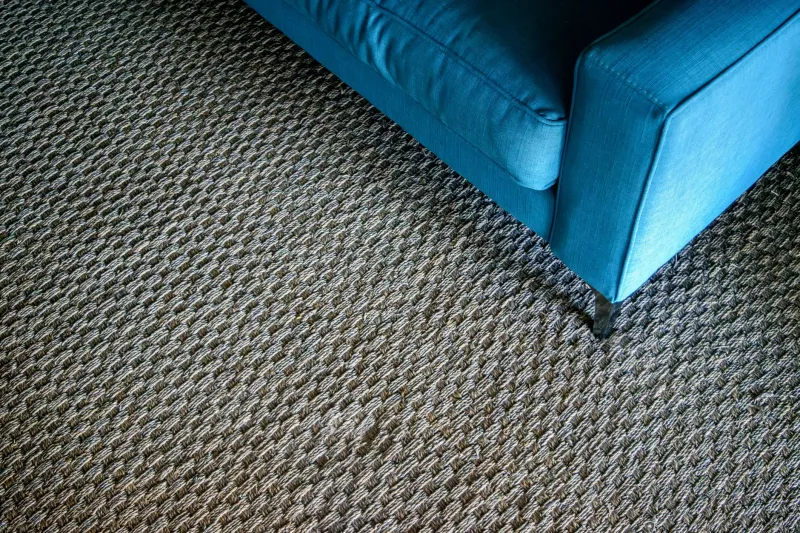
Here's the counterintuitive bit. A deep, fluffy saxony feels like it should be the quietest option, but a tight, dense loop or a firm twist often performs better on impact noise because there's less air and movement in the pile. It also wears better in doorways and on stairs.
Wool and synthetic both work. Wool tends to age gracefully and holds its density; a good solution-dyed nylon or polypropylene is hard-wearing and easier to clean. The thing to look at on the label isn't the depth of the pile — it's how tightly packed it is.
If you're renting or fitting out a box room, carpet tiles with an acoustic backing are a practical middle ground. They won't match a full broadloom fit for sound, because the seams and joints let a little more through, but they're a big improvement on bare boards and you can take them with you.
Stairs are where complaints usually start
If you share a wall with a stairwell, or live below one, the staircase is public enemy number one. Every tread takes a direct hit, and the sound goes straight into the structure.
A full-width carpet on the stairs will always outperform a narrow runner. Underlay on the treads and risers helps, and it's worth asking your fitter to check for loose treads and creaks before the carpet goes down — no underlay in the world will silence a stair that's mechanically loose. It's also the moment to look at anything under the stairs, since voids can act like a drum.
When a rug really is the answer
You don't always need to carpet a whole flat. If you're renting, or the problem is one specific spot, a properly sized rug with a dense felt or rubber anti-slip pad underneath can make a genuine difference to footfall and to echo in a room with high ceilings.
Go bigger than feels natural — a rug that sits just under the coffee table won't do much, whereas one that runs close to the walls and under all the furniture feet catches far more impact. Under a desk chair with castors, choose something with a firm surface rather than a deep pile that will flatten within a month.
What carpet can't fix
This is the part worth being blunt about. Sound also travels around the edges of a floor — through joists, along pipes, through gaps where floorboards meet skirting, up a chimney breast, through unsealed service holes. That's called flanking transmission, and it bypasses your lovely new underlay entirely.
If the floorboards are gappy, filling them before fitting carpet is money well spent. If the noise is voices and telly rather than footsteps, the weak point is the wall, not the floor, and a carpet won't change that. If your neighbour has bare boards above you, obviously, the fix is on their side of the ceiling.
A sensible order of operations
Start with the lease and the neighbour. Then work out whether it's impact or airborne noise. Then check the floor itself — gaps, loose boards, an old collapsed underlay, an existing hard floor laid over a poor substrate. In a lot of flats, simply replacing a floating laminate with a well-fitted carpet and dense underlay is the single biggest improvement available.
Then choose density over depth, budget for underlay as a real cost rather than an afterthought, and have it fitted edge to edge with no gaps at the skirting. Small details, but they're the difference between a carpet that absorbs sound and one that just sits there.
If you're local to us and unsure where to start, pop in with a photo of the room and a rough idea of the building — a 1930s semi and a Victorian conversion need very different answers.